Mehmood Khan
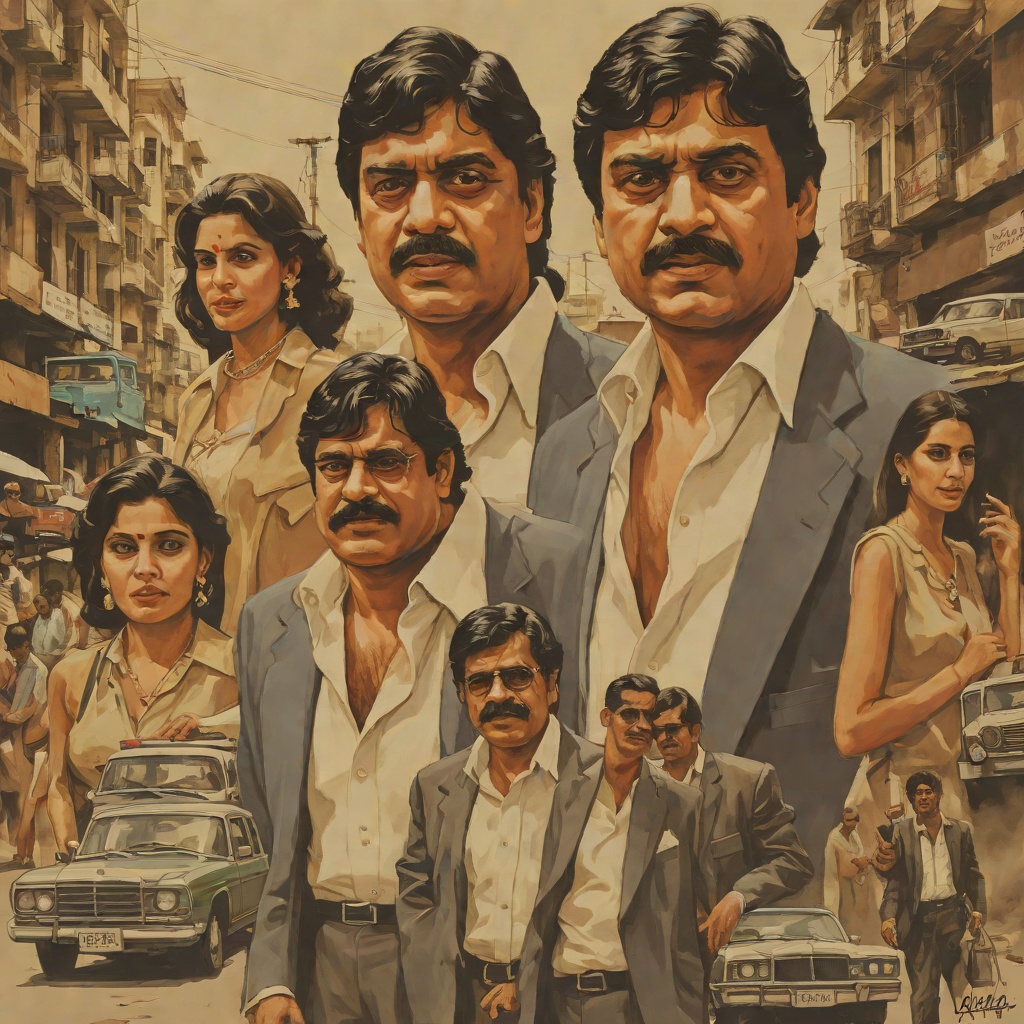
Mafia Queens of MumbaiMehmood Khan, a wanted gangster in Mumbai's underworld, is a figure defined less by his own actions than by the manner of his death and the grief it unleashes. Known to his associates as Mehmood Kalia, a nickname derived from his dark complexion, he is introduced through the eyes of his devoted wife, Ashraf Khan, whose love for him and ignorance of his criminal life frame his tragic story. His killing in a police encounter at Santa Cruz airport is presented not as a moment of justice but as a lie, a state-sanctioned execution that shatters his family and exposes the violent machinery of the city's crime world.
Identity and Marriage
Mehmood Khan's identity is constructed almost entirely through his relationship with his wife, Ashraf. A strikingly attractive young woman, Ashraf fell in love with Mehmood when she first met him at a friend's wedding. When he later asked her to marry him, she did not hesitate for a moment before saying yes. In the five years they were together, his one aim was to make her happy. Ashraf, who had grown up in a rigid, conservative family, embraced the freedom that marriage to him gave her, travelling with him and living the life of a queen. Her love for him knew no bounds, and even a brief period of separation hit her hard. The only problem Ashraf had with Mehmood was that she was unsure about what it was he did for a living. She did not like the men he hobnobbed with and the way they referred to him, taking offence at the nickname Mehmood Kalia. When she complained, he affectionately said it was a non-issue, and when she conveyed her apprehensions about his working with them, he merely told her not to worry. He would never explain what his work entailed exactly; what he did, where and with whom he went, was something she was completely ignorant of.
The Airport Encounter
The central event of Mehmood's story is his death at Santa Cruz airport, an encounter that unfolds with chilling precision. After a ten-day silence, Mehmood called Ashraf, his voice husky and loud on the international line, saying, "Jaan, I will be back this evening. Please come to the airport..." He gave her the flight details, and an overwhelming feeling of happiness gripped her. She rushed home to get ready to meet her husband. The clock on her dressing-table struck three as she slipped the last of her gold bangles on her arms; Mehmood would be at the airport in an hour. She hurriedly picked up her handbag and headed out for the main road at Nagpada, deciding to take a cab instead of a train. She reached the airport by 4 p.m., surrounded by people carrying placards, flowers, or small gifts to welcome their loved ones. Ashraf looked down at her bare hands and felt guilty, though she knew Mehmood was not a materialistic person and that nothing on earth would match the happiness he would feel on seeing her. Over the noise of the crowd, she thought she heard faint gunshots from the parking lot. Her heart pounding, she ran towards the parking lot, where she spotted several policemen huddled together at one end. A jeep that had earlier been parked behind her went past her, along with an ambulance, out of the airport. When she reached the policemen, she saw a pool of blood near a parked taxi, the cops preoccupied with drawing white markings on the ground. She froze, still hoping that Mehmood, who she had seen standing, smiling at her, only five minutes ago, would come and reassure her that he was fine. But there was no sign of him.
The Search for Truth
Ashraf's desperate search for her husband reveals the official story's fragility. She overheard one of the policemen say that the man who had been shot had been taken to Cooper Hospital. She hailed a taxi and directed it to the hospital, but when she reached, both the reception and the hospital staff were unaware of any patient who had been admitted with gunshot wounds. They asked her to instead inquire with the Andheri police station. Ashraf, who had led a protected life so far, steeled herself and went from station to station in the area, trying to find out where her husband was. Finally, a policeman directed her to J.J. Hospital. At J.J., her worst fears were realised: she was told that a man named Mehmood Khan, a wanted gangster, had been shot dead in an encounter at Santa Cruz airport. Ashraf knew this was a lie. Mehmood would not have been able to carry a gun past airport security; there was no way he could have been armed. She asked to see the body immediately, with the small hope that perhaps it was not her Mehmood, after all, that they were talking about. One of the nurses led her to the morgue. She entered the dimly-lit room and began to tremble when she saw the wrapped bodies. Her legs shook in nervousness; she wished she did not have to witness this all alone. Pitying her, the nurse held Ashraf's hand firmly and took her to a body. It was him. It was the same man she had seen a few hours ago, the same man who had smiled at her before he had disappeared into a crowd.
Narrative Role and Significance
Mehmood Khan's story functions as a stark illustration of the "fake encounter," a practice where the state eliminates wanted criminals under the guise of a shootout. His death is not an isolated incident but part of a pattern of extrajudicial violence that runs through the book, which chronicles the lives of women connected to Mumbai's underworld. The narrative, drawn from the book's broader exploration of crime and its human toll, uses Ashraf's perspective to humanize the victim, transforming Mehmood from a faceless gangster into a beloved husband whose only crime, in his wife's eyes, was his secrecy. His killing also underscores the gendered nature of this violence: it is Ashraf who must navigate the police stations and the morgue, who must bear the weight of a truth she is not meant to know. The encounter, officially a triumph of law enforcement, is revealed to be a lie, a moment where the state's power is exercised not against crime but against the family left behind. Mehmood's legacy, therefore, is not his criminal record but the grief of a woman who loved him without knowing who he truly was, and the chilling reminder that in Mumbai's underworld, even a smile can be a farewell.